DroneEngage DataBus
DroneEngage Databus is the protocol that is used to communicate between different modules in the unit. The main component of DroneEngage for each unit is the Communicator module. The communicator module is the only module that can runs alone without any other module. however it will not be useful, but it will appear on WebClient as a separate unit.
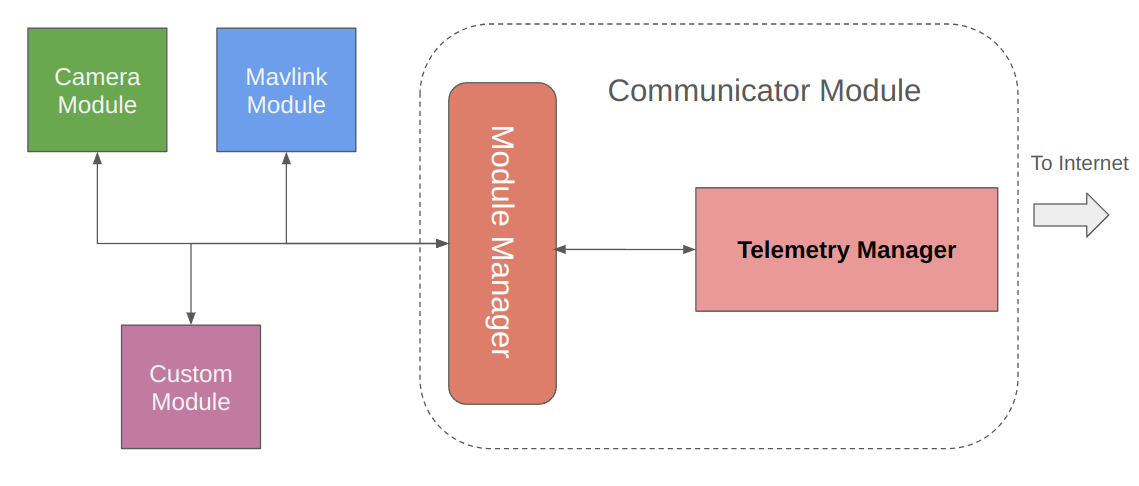
As we can see in the above diagram Communicator Module contains -among other components- Module Manager and Telemetry Manager.
- Telemetry Manager is the component that is responsible for communicating with other modules, and webclient-whatis via srv-communication.
- Module Manager is the component that is responsible for communicating with other modules of the same unit.
- Module Manager is mainly a publisher subscriber module, where each module can subscribe in one or more messages listed in Andruav Communication Protocol Messages
using message type.
- Module Manager processes messages coming from Internet server via Telemetry Manager and then forward it
to modules subscribed in these messages.
- It also does the opposite and forward messages from modules to Internet.
- Modules intercommunication is also possible, for example communicator mavlink module determines location, which is used by camera module to label images with location before saving it.
- Communication between modules in this part is implemented using UDP sockets, so it is very fast, also the inner layer handles data chunks so you
can sends data of any size between modules without need to worry about how to slice or handle them.
de_common Architecture
The de_common directory provides the core communication infrastructure for DroneEngage modules. It implements a robust UDP-based messaging system that enables reliable inter-module communication with automatic message chunking, reassembly, and module discovery.
Directory Structure
The de_common directory is organized into two main components:
de_databus/ - Core communication classes
- de_facade_base.hpp/cpp - High-level API facade for module communication
- de_module.hpp/cpp - Module management and routing functionality
- udpClient.hpp/cpp - UDP transport layer with chunking support
- de_message_parser_base.hpp/cpp - Base class for message parsing
- de_common_callback.hpp - Callback interface definitions
- messages.hpp - Message type definitions and constants
- configFile.hpp/cpp - Configuration file handling
- localConfigFile.hpp/cpp - Local configuration management
helpers/ - Utility classes and functions
- helpers.hpp/cpp - General utility functions
- json_nlohmann.hpp - JSON parsing library wrapper
- colors.hpp - Console color utilities
- getopt_cpp.hpp/cpp - Command line argument parsing
- util_rpi.hpp/cpp - Raspberry Pi specific utilities
Core Components
UDP Client (CUDPClient)
The UDP client provides the foundation for all inter-module communication:
Key Features:
Message Chunking: Automatically splits large messages into configurable UDP chunks (default 8KB, max 64KB)
Automatic Reassembly: Receives and reconstructs chunked messages in the correct order
Thread-Safe Operation: Uses mutex protection for concurrent send/receive operations
Module Discovery: Periodic broadcasting of module identification for network discovery
Callback Architecture: Delivers reassembled messages through a clean callback interface
Protocol Flow:
Initialization: Creates UDP socket, binds to local port, starts receiver and ID broadcaster threads
Message Sending: Large messages are chunked with 2-byte headers (sequence number + end marker)
Message Reception: Receiver thread reassembles chunks and delivers complete messages via callback
Module Discovery: Periodic JSON ID broadcasting enables automatic module detection
Module Manager (CModule)
The module manager handles routing, registration, and message processing:
Core Responsibilities:
Module Definition: Sets module class, ID, key, version, and message filters
Message Routing: Handles inter-module, group, and individual message routing
JSON Message Construction: Builds properly formatted messages with metadata
Registration Management: Manages module identification and feature advertisement
Callback Chain: Connects UDP transport to application-level message handlers
Module Features: Modules can advertise capabilities using feature flags:
R- Receiving telemetryT- Sending telemetryC- Image captureV- Video captureG- GPIO controlA- AI recognitionK- TrackingP- Peer-to-peer communication
Module Classes: Standard module types include:
comm- Communication modulefcb- Flight control boardcamera- Camera modulep2p- Peer-to-peer modulegen- Generic modulegpio- GPIO moduleai_rec- AI recognition moduletrk- Tracking module
Facade Base (CFacade_Base)
The facade provides a high-level API for application developers:
Public API Methods:
requestID()- Request module identification from target partysendErrorMessage()- Send structured error messagesAPI_sendConfigTemplate()- Send configuration templates to modules
Design Pattern:
Singleton Pattern: Global instance accessible via
getInstance()Facade Pattern: Simplifies complex subsystem interactions
Delegation: Forwards operations to the underlying module singleton
Message Flow Architecture
Outbound Message Flow (Application → Network)
Application Layer: Uses facade APIs (e.g.,
requestID())Facade Layer: Calls
m_module.sendJMSG()on module singletonModule Layer: Constructs JSON message with routing metadata
Transport Layer: UDP client chunks and transmits via UDP
Inbound Message Flow (Network → Application)
Transport Layer: UDP client receives and reassembles chunks
Module Layer:
onReceive()parses JSON, validates routing, handles special messagesApplication Layer: Registered callback receives parsed message
Parser Layer: Application parser processes message type and command
Integration Example
Here’s how a typical DroneEngage module integrates with de_common:
Initialization:
// Define module characteristics
CModule::getInstance().defineModule(
    "camera",           // module class
    "CAM_MOD1",         // module ID
    "cam-001-abc123",   // unique module key
    "v1.0.0",          // version
    message_filter     // JSON message filter
);

// Initialize communication
CModule::getInstance().init(
    "192.168.1.100",   // communicator IP
    6000,              // broadcast port
    "0.0.0.0",         // listen address
    6001,              // listen port
    8192               // chunk size
);

// Set message receive callback
CModule::getInstance().setMessageOnReceive(onMessageReceived);
Sending Messages:
// Use high-level facade API
CFacade_Base::getInstance().requestID("target-module-id");

// Or use direct module API
Json_de message = {
    {"command", "capture_image"},
    {"params", {{"quality", 90}}}
};
CModule::getInstance().sendJMSG("target-module-id", message, TYPE_AndruavMessage_RemoteExecute, false);
Receiving Messages:
void onMessageReceived(const char* raw_data, int len, Json_de json_msg) {
    // Parse and handle incoming message
    std::string message_type = json_msg["1"];
    if (message_type == TYPE_AndruavMessage_RemoteExecute) {
        // Handle remote command execution
        parseRemoteCommand(json_msg);
    }
}
Configuration and Deployment
Configuration Files:
configFilehandles global configuration settingslocalConfigFilemanages module-specific local settingsJSON-based configuration for easy modification
Build Integration:
Header-only design for easy inclusion
Minimal external dependencies (only standard library and JSON parser)
Cross-platform compatibility (Linux, Windows, embedded systems)
Thread Safety:
All public APIs are thread-safe
Mutex protection for shared resources
Separate threads for receiving and ID broadcasting
Performance Characteristics
Throughput:
UDP-based transport for low latency
Configurable chunk sizes optimize for network conditions
Zero-copy message passing where possible
Reliability:
Automatic message reassembly handles packet loss
Sequence numbers ensure proper chunk ordering
End-of-message markers detect complete transmissions
Scalability:
Singleton design minimizes memory footprint
Efficient JSON parsing with nlohmann/json
Threaded architecture handles concurrent operations
This architecture provides a robust foundation for building scalable DroneEngage modules that can communicate reliably over various network conditions while maintaining clean separation between transport, routing, and application logic.